Wednesday, July 6, 2016

Beaverhead ski rambling

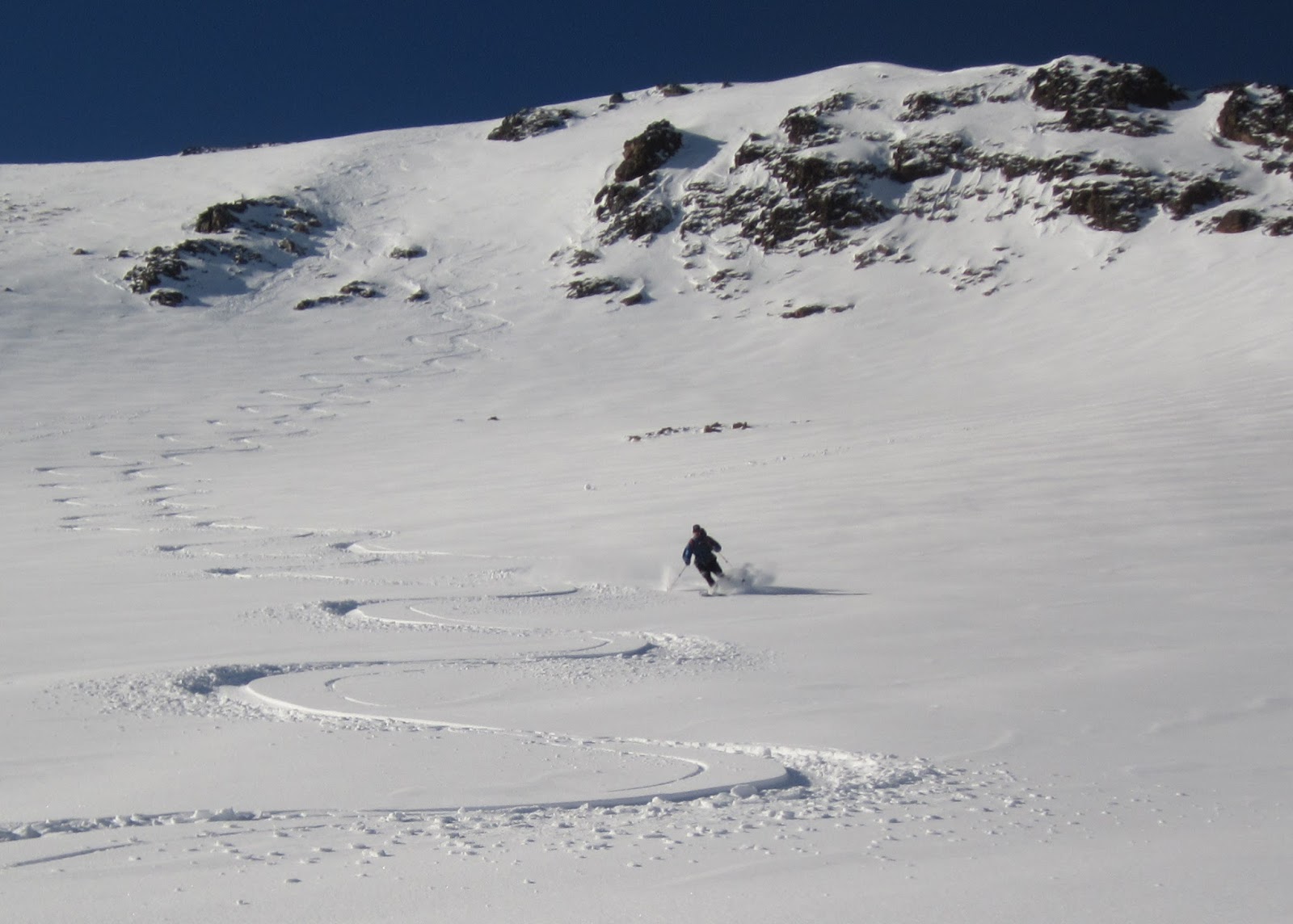
A warm spring has ski season drawing to a premature close, but I was able to sneak away to the Big Hole valley for two days of skiing. No agenda, just camp and ski.

Sacajawea peak couloir bounce
Couloirs in the Sacajawea cirque.
After a crisp morning driving the last few miles of jeep road and firing up the stove for coffee and breakfast, I rolled out of the trailhead shortly after 7 am.  The trail to and around upper Miner lake was quick, and I was trudging up the first run of the day from the lake inlet less than two hours after leaving the car.  I opted to ski one of the steeper couloirs in the northern edge of the cirque first before the snow got too warm.  The ascent was straightforward, and I was soon transitioning at a tiny perch below the ridgeline cornice.  The steep hanging upper snowfield demanded full attention. Fortunately, the technical difficulties were brief, and I was soon safe and sound in the gut of the couloir.  The rest of the run skied well.
First run.  All cued up for couloir skiing!
Homer Youngs  peak in the background.
Lunch break after the first run.
Next up was a pair of couloirs on the northern flank of Sacajawea peak.  Both runs terminate a few hundred feet below the top, and I am yet to summit this craggy mountain.  A long boot/skin/boot put me on top of the first run.  To my delight, the snow was excellent, just-plain-fun couloir skiing.  I stopped at the tarn above the lake and spun a lap in the other fork of the couloir, which was slightly shorter but equally enjoyable, with the added bonus of skiing the exit chute to the lake.  Second lunch was deluxe with good food and a little shoes-off nap.
Looking up the second and third runs.
Looking down the third run.
From the lake, I made another almost 2,000 foot climb to a similar couloir system, skied it, and made a final exit climb to the high ridge east of the cirque.  The final few hundred feet of scree to the ridgeline were loose and acutely unenjoyable.  Fortunately, I wasn't in a hurry, and slowly slip-slid my way up.  I traversed the rocky ridge crest east for almost an hour as gusty winds blew high clouds in and out.  The long exit snowfield was a great last run. After wading the creek with ski boots on, a few miles of jogging had me back at a mosquito-infested car by early evening.  Great day in one of the finest couloir skiing zones around.  Something around 9,000 vertical feet done in about 11.5 hours.
Upper Miner lake.  from high on Sacajawea.
To exit, I traversed the right skyline ridge and skied the most
continuous snow stripe, crossing the creek below the lake outlet.
Big Swamp creek exploration
I have heard that the skiing is good around Ajax peak, so I drove up the drainage without an agenda before settling in for an evening of cooking and relaxing in solitude.  I decided to ski an unnamed 10,000 foot peak east of the crest because of its two prominent and aesthetic ski lines and easy access from the car.  In the morning, I struck out off trail to the base of the peak after a hearty breakfast of fresh coffee and leftover curry.  Morning visibility was nil, but fortunately the ski runs were obvious, the rain never came, and there was enough rock at the edge of the snow to keep vertigo in check.
Looking up at the two lines in Big swamp creek (far left and right).
They are better than they look in the photo.
The first run was a long, clean gully well east of the summit proper, and the second was the best of a group of gullies which drop from near the summit.  They were both highly recommended runs, and I was surprised to see an old set of ski tracks.  Having skied the best lines in the cirque, I devised a plan to summit, ridge traverse to the next cirque west, and ski it out to the car.  The climb to the summit was enjoyable, but to my dismay, there was very little snow in the adjacent cirque.  With plenty of time and limited other ski options, I traversed out there anyway, eventually linking snow patches down to a remote lake at snowline.  Since there was not enough snow to justify a second run, I peeled ski boots off and took a nice nap in the sun.  The exit was easy. Shod in running shoes, I was back at the car after a short bushwack to the road and a blissfully short 10 minutes of road jogging.  Aside from working through some residual fatigue, this was a relaxed day, less than 5,000 vertical feet done in about 7 hours.
Second run. Good stuff!
Looking west to Ajax peak and the snowless cirque that I scrambled out to.

Tuesday, June 14, 2016

Running races, summer 2016

With my primary focus this summer on unstructured adventures, the plan is to wrap all running races into a single post.

Note: these reports are written in large part for myself, and as such there will be a lot of personal ruminating, as opposed to inspiring writing about the race.  Also, note, I am a relatively slow runner.  Find someone faster to follow if you want more exciting front of the pack action.

Snowbowl 15k, August 6

I signed up last minute for the Snowbowl 15k.  With good knowledge of the course and reasonable fitness, my goal was to run a fast, even race and not blow up.  I also allowed a respectable taper, so there were no excuses for a bad race.  After the normal warm up and pre-race jitters, we were off.  To my surprise, the start was fast, and it felt more like a road 10k, so I reluctantly settled a little farther back in the pack than anticipated, chugging along right at anaerobic threshold.  There is only one big climb, and after the initial sorting, I slowly began working up through the pack, but was only able to pass five or so runners before topping out.  I started down just a few yards behind the phenomenally talented Ella Degrandpre (fastest 15 year old I know of, hands down).  While Ella put me to shame on the up, I was able to harness enough energy to pass her and push ahead into no-man's land.  About a mile out, I also passed Nicole Hunt.  I was pleased to maintain a 6 min/mile pace on the down, but it was not enough to pass anyone else before crossing the line in 11th place, 1.14.  A few calf twinges in the last mile were confirmation that I had pushed reasonably hard.

This race was a lot of fun.  I could have dug deeper and found a minute or two on the climb, but otherwise I felt good about my race.  Effort was right at anaerobic threshold for the climb (avg HR ~169), and hard enough on the down (avg HR ~164).  Equally important, I didn't have to stop for any of the myriad possible reasons (eating, sideache, cramping, peeing, tieing shoes, etc) the entire race, which hopefully offset any deficiencies in pushing to the limit.

Scout Mountain 60k, June 4

I returned to the beautiful trails of Pocatello in early June for another go at this runnable course.  My primary goal was to run an even race with a strong secondary goal of improving my solid time from two years ago.  The race went well.  A bunch of runners went out fast, but I started off at a reasonable 50k pace and rolled with a group, topping out somewhere around 10th place.  After advancing several spots by skipping the first water stop, I ran at a bright but still slightly restrained pace all the way to the first aid, then ran to the second aid with two other runners.  I ran into the 25k aid nine minutes behind my previous time, but feeling much better.  

The second half of the course is dominated with a big, beautiful and hot climb over Scout mountain.  It makes or breaks most runners' races.  My two fellow 60K runners took off blazing up the climb, and I them go, hoping for a fade on their part.  Sure enough, over the course of the next two hours, I would pass them as well as the 3rd place runner, who was suffering mightily in the heat.  My slower early pace start started to return dividends, as I still felt reasonable, which allowed much more uphill running, and no cramping on the long downhill to last aid station.  In terms of competition, I was in no mans land for the last half of the race, with 10+ minute gaps on both sides. While I was tired for sure, I was pleased to have enough energy in the tank to more or less hold the pace over the last 10k.  I topped out on the last climb gassed and with some minor calf, adductor and hip flexor cramps, but they stayed at bay enough to push reasonably to the finish, with one spectacular cartwheeling stumble to keep things entertaining.  I ran 6.41 over 60K with about 8,500 feet of elevation, which was a six minute improvement over my 2014 time.

As always, thanks to overall awesome all around person Luke Nelson for organizing this event, and for everyone from the community who pitches in to make it so enjoyable.  In addition to a good course, the low key vibe coupled with top notch support and execution make for an enjoyable event.

Training geek comments for future reference:
Overall, I continue to be satisfied with incremental improvement. While I could take more risks and probably find another minute or two along the way, I am gaining confidence in pacing and general race execution for a solid 50k race.  In terms of effort, I was able to push incrementally harder than in similar races last year.  I used a HR monitor and ran most of the uphills with my HR in the low to mid 150s, and ran the downhills in the upper 140s.  I tried slowly running more of the douche grade climbs instead of struggling to walk fast, which seemed to work, and I kept the pace comfortable/in check on the first few downhills.  Also, I took some time at aids to wage war on the heat, drinking extra water and soaking my head and shirt. I haven't had any desire to heat train ever (sounds awful), and haven't quite ultra-geeked out enough to get an ice pack neck band, but so far even minor attention to heat makes a big difference.

My training leading up to the race was different than in the past.  A sprained ankle only allowed me to start running about ten weeks out from the race, and the first two weeks were spent slowy ratcheting up mileage and ankle confidence.  Weekly spring running volume was comparable to past years, but I did fewer long runs, and did more quality and strength work, and ran more each day on average.  I am still following Mike Wolfe's training plans with heavy modifications for running and they have been great, especially for strength/stability/injury prevention work. Aside from a few quad banging top to bottom repeats on Sentinel, I generally favored moderate grades to get a lot of leg turn over.  While my cardiovascular fitness isn't any better than in the past, I don't think it has suffered, and I my running form and general muscular resilience are slightly improved.

Honestly, my biggest current worry is trying to figure out why my general level of energy has been poor for the past month or so.  I did get a little sick, but even before and after, I have been sporadically sluggish, struggling through some runs and feeling OK for others.  I am hoping energy levels will stage a major come back after a rest week of biking and skiing.

Superfun(d) 10k, April 23

On a very rainy Saturday put a big kibosh on our plans, so Leah and I showed up and ran the Superfun(d) road 10k hosted by Run Wild Missoula.  I did a minimal two day taper, but showed up feeling adequately rested for a decent performance.  Having never run a proper length 10k race, I headed out at a goal pace of 5.50 miles and just tried to hang on.  I was able to hold the pace for the race, although it was fiercer than I had hoped for over the last third.  I moved up over the first two miles, until I was running in the lead, which I held to the finish.  I don't remember my exact time, but it was 37 something, 5.50 mile splits.

Training geek comments for future reference:  I wore a HR monitor, and was surprised that I couldn't keep 'er higher than 170 - maybe I wasn't rested as well as I thought, or perhaps lactate threshold HR is lower than I thought.  For now, I'll just try to run lactate threshold sessions easier and keep tinkering.

Tuesday, May 31, 2016

Scapegoat - Red Mountain

Jeffrey walking to the summit of Red Mountain.
I have always wanted to spend more time in the Bob Marshall, so it seemed fitting to explore the area around its highest peak on skis.  My first trip was on a cold, blustery day in mid May, hoping for a reasonable morning weather window that never materialized.  As such, I used a wonky low elevation approach to Red mountain before climbing the Southeast face to a point just below the summit ridge. Stymied by a blustery, miserable whiteout, I bailed, and the remainder of the day was spent skiing various shorter runs on the way back to the car.
Time to head back to the car after getting shut down by weather.
Tail firmly tucked between my legs.
A week later, much improved weather allowed a direct climb to the summit.  The approach route is somewhat convoluted, but it isn't actually too far, just a bit bush wackey and awkward in spots. With nicely refrozen snow, Jeffrey and I climbed to the top of Red mountain in under three hours via the south ridge.  We rallied an early start, so snow on the Northeast face was still frozen, but it was not too steep or scary, and I had a blast.  Firm conditions made for a quick walk back up, and we traversed to the next peak south (Blonde mountain?) before dropping into the cleanest couloir on the Southeast face.  The run was great. The face has four nice couloirs, and a return trip is warranted.
At the bottom of the Northeast face of Red Mountain.
At the bottom of our second run on Blonde mountain.
The couloirs in the cirque are better than they look in the picture.
We followed bear tracks to the top of our short third run, which would have been better if we had enough time to extend it another few hundred feet to its logical terminus.  Instead, we exited stage right for a final climb to the basin which would most cleanly deposit us near the car.  One last enjoyable run was followed by a long shuss to the end of the snow, which was remarkably smooth.  We were both feeling relaxed at the end of the day, and just walked back to the car in about an hour from snowline in running shoes. It was satisfying to return to this nice high corner of the Scapegoat and have such a remarkably effortless day.
Climbing to our fourth run, with our third run in the background.
Looking down our fourth run.
Our egress route is visible along the bench on the skier's right side of the basin.
End of the snow.
Between the long drive, shorter runs, and slightly awkward approaches and egresses, the Copper creek area a little off compared to other Missoula spring skiing locales.  In addition, about half of the skiiable terrain is open to snowmobiles, and it appears they hit it pretty hard well into the spring.  However, there is a lot of terrain, and the climate (drier) and spring snowpack (more wind consolidated/better potential for good corn) are reason enough to keep it on the radar, especially as the road opens up in May, and on days when conditions closer to Missoula are sub optimal.  Finally, while Red mountain is the technical high point, the skiing is no better than more easily accessible options closer to the car.  For stats, a little over 6k vert, done in about 7 hours car to car.
Grizzly tracks.

Thursday, May 5, 2016

Swans - Holland Peak to Lake traverse

Last few steps to the lookout.  We were tired, but barring
consumption by bear, another excellent new traverse was in the bag.
I was once again able to convince Andrew and Jeffrey to join for an adventure into new ski terrain, this time along the high crest of the Swan range.  I have completed this and longer traverses in the summer, but was excited for a day of stringing together striking runs on skis.  We left a dreary and cold Missoula in the evening evening, and did the straightforward car shuttle before nodding off for the night. We started hiking by headlamp at 5 am after an adequate night of sleep. I wasn't feeling the pressure to charge in the pre-dawn, but even with my slower pace, we crested the range at 8 am, just three hours after leaving the car.  Thanks to Andrew for putting a track in from the car to the crest of the range.
Jeffrey climbing above lower Rumble lake in the morning.
Beta - My preferred snow route is up this open couloir, which bypasses upper Rumble lake entirely.
Andrew gearing up in front of Holland.
From the crest, I prefer to ski a short run to the east and avoid nasty hanging glide slabs on the summer South ridge route.  The snow was firm but enjoyable, and we were soon on our way up Holland peak's SE face.  It was pretty cool to see an old set of two ski tracks on our route.  Folks getting after it - I love it.  Andrew and Jeffrey were still setting a stout pace, so I settled in and tried to stay close.  We were on the summit around 9:30.  The SE was just soft enough for great skiing.  We took an abbreviated run to the tarn, then did a long traverse below the NE face of Buck mountain.  We crossed several impressive sets of grizzly tracks on the traverse.  I blindly lead us over two low cols onto the SE face of Buck.  Fortunately, the route flowed well, and we skinned easily to the summit.  This route was much easier than climbing the N ridge of Buck.  We skied good corn for 1,900 vertical feet all the way to upper Terrace lake.  It was a great, casual run.
Jeffrey at the bottom of our first access run.  Note massive (bigger than it looks) glide avalanche activity behind him.
This is common, and we gave it a wide birth.
Andrew starting down Holland peak.
Andrew and Jeffrey coming up Buck.
First few turns off the summit of Buck mountain.  Photo: Andrew Mayer
I had originally planned to climb through a steep col to peak 8,485, but threatening cornices and a touch of apathy had us deciding to bypass the peak on the east and head straight to Rubble lake, then peak 8,450. It was a good decision, as the bypass was efficient, and the entire climb was delightful.  We summited way ahead of schedule, and as a result it was decided to ski an aesthetic North couloir all the way to Woodward lake.  The couloir was excellent. First descent (not that it matters)?  The snow deteriorated well before the lake, but we skied the full run anyway.  I would like to return to 8,450, since there are good looking ski runs on each of its N, E, SE, SW, W and NW aspects!
In the upper North couloir on 8,450.  Photo: Andrew Mayer
With just one climb to go, we took another nice long break at the lake, which included an extended water getting mission.  It is a long way to the Holland lookout, and I didn't really have a route in mind, so we nosed our way up the line of least resistance.  The last push (roughly up the summer trail) had a lot of sloppy snow, but we pushed through without too much discontent.  From the lookout, we were only able to ski a thousand vertical feet before running out of snow. Fortunately, we were able to hop directly from snow to the summer trail, and an hour of easy running got us back to the car.  The day checked in right around 11,000 vertical feet, done in about 11.5 hours point to point moving at a stout pace with long breaks.  Great day.
Don't fall in!  Tricky water getting.
Holland lookout, with the missions in the background.
It was surprising how well this line linked up.  Every ski run was good (except the short run from the lookout), and the climbs were for the most part very straightforward and efficient.  One could make the outing shorter by not climbing Holland, and by skiing Southwest from 8,450, either directly to the foothills trail (bushwack of unknown heinousness required), or about half way to the valley before traversing to the summer trail.  With good weather and stability, a simplified outing would be less than 8,000 vertical feet and doable for an "average" touring party.  One could also do an excellent Holland SE/Buck SE/8,485 NW loop all from the Rumble lake trail head.  And, it is hard to not wonder if a Smith Creek pass to Holland lake on skis is realistic.  For gear, I used my heavier TLT 5/BD Revert setup.  This was a huge mistake, as I struggled all day to keep up with Andrew on his light setup.  At least I was able to get new school and butter my turns on the downhills.

Sunday, April 24, 2016

Bass Creek to Lolo Traverse V.2

Looking back at our runs on St. Joe and Pyramid Butte
(obvious open face) from the west ridge of Sweeney.
Andrew and I did the Bass to Lolo traverse on a warm Sunday in mid April.  The goal was to build on a previous traverse, skiing off Bass peak and the Pyramid Buttes instead of bypassing them via high passes.  In order to get it all done by dark, I suggested a painfully early start time. Andrew was game, and after an abbreviated night of sleep, we were hiking at 4 am.  The approach in the dark was nice, and we were at the base of big St. Joe at first light.  We kept shoes on and scrambled just east of the creek which drains the Southeast face.  Since the snow was firm, we kept the runners on to within about 1,500 vertical feet of the summit.  Andrew was setting a brisk pace, so it was a quick skin to the summit.
Sunrise skinning on St. Joe.  Photo: Andrew Mayer
Andrew leading the charge on the summit ridge of Big St. Joe.
We skied the North face, which after some rock and sastrutggi negotiation, ended up harboring surprisingly good powder.  This face is scoured much of the winter, but there was enough late season snow for it to be an incredible 3,000 foot peak to creek run. Maybe a touch icy at the bottom, but not too bad.  I refilled water in Sweeney Creek, and we were off up the south face of Pyramid Butte.  Andrew was still blazing away, so I just settled in and followed his tracks.  Our pre-dawn start paid off, as we were able to get up the big south face before the day warmed up too much.  I was not sure what we would be able to ski off the top, but fortunately my preferred line, the Northeast face, skied really well.  Small hanging face to soft powder skiing through alpine larch to a nice powdery exit couloir.  Great stuff.  We were on a roll, way ahead of schedule, and enjoying the day.

Andrew skiing the north face.
A happy Brian cruising the North face. Photo: Andrew Mayer
Climbing low on the South face of Pyramid Buttes.

Andrew dropping into the unknown on Pyramid Buttes.
It ended up just being great, straightforward top to bottom skiing.
An uneventful climb put us on the west ridge of Sweeney peak.  Andrew pushed up to an unnamed high point, and I was content to relax for a few minutes and take it all in.  The rolling run down to One Horse lake was not as striking as the previous two runs, but it had good skiing all the way to the lake.  It is a bit of a push from One Horse to the summit of Lolo, but we had both done it before, so we put our heads down and got it done.  From the summit, we still had plenty of time, so we skied the Lantern lake couloir to the lake, then continued down another few hundred vertical before putting skins on for one last warm climb to Lantern ridge.  I was mildly concerned about missing the unmaintained Lantern ridge trail on the exit, but found it and followed it like a hawk down to snow line.  Since the Mormon creek road is still closed, we had to get all the way down to the valley, but it only took an hour of relaxed jogging on the Lantern ridge trial to reach the car. We ended up climbing and descending something north of 12,000 vertical in almost exactly 12 hours at a stout but sustainable pace.
Andrew dropping into Carlton creek.
Cheesey photo on Lolo peak.
Andrew skiing good spring powder below the Lantern lake couloir on Lolo.
Rolling out to the valley at the end of the day.
I understand that the Bass to Lolo traverse is a big day, but it flows well enough to be doable, and should get done more often. The one major caveat is that it is fairly committing, since backtracking from North of the Pyramid Buttes would take a long time. There are many possible variations, but this high route had such amazing skiing that it is hard to imagine a more elegant line.   The upper reaches of Sweeney creek are wild and magical, and it is awesome to spend time in such a wild place so close to town.