Thursday, February 5, 2015

Big St. Joe, South Gully East

Leah skiing on the South face of Big St. Joseph peak.
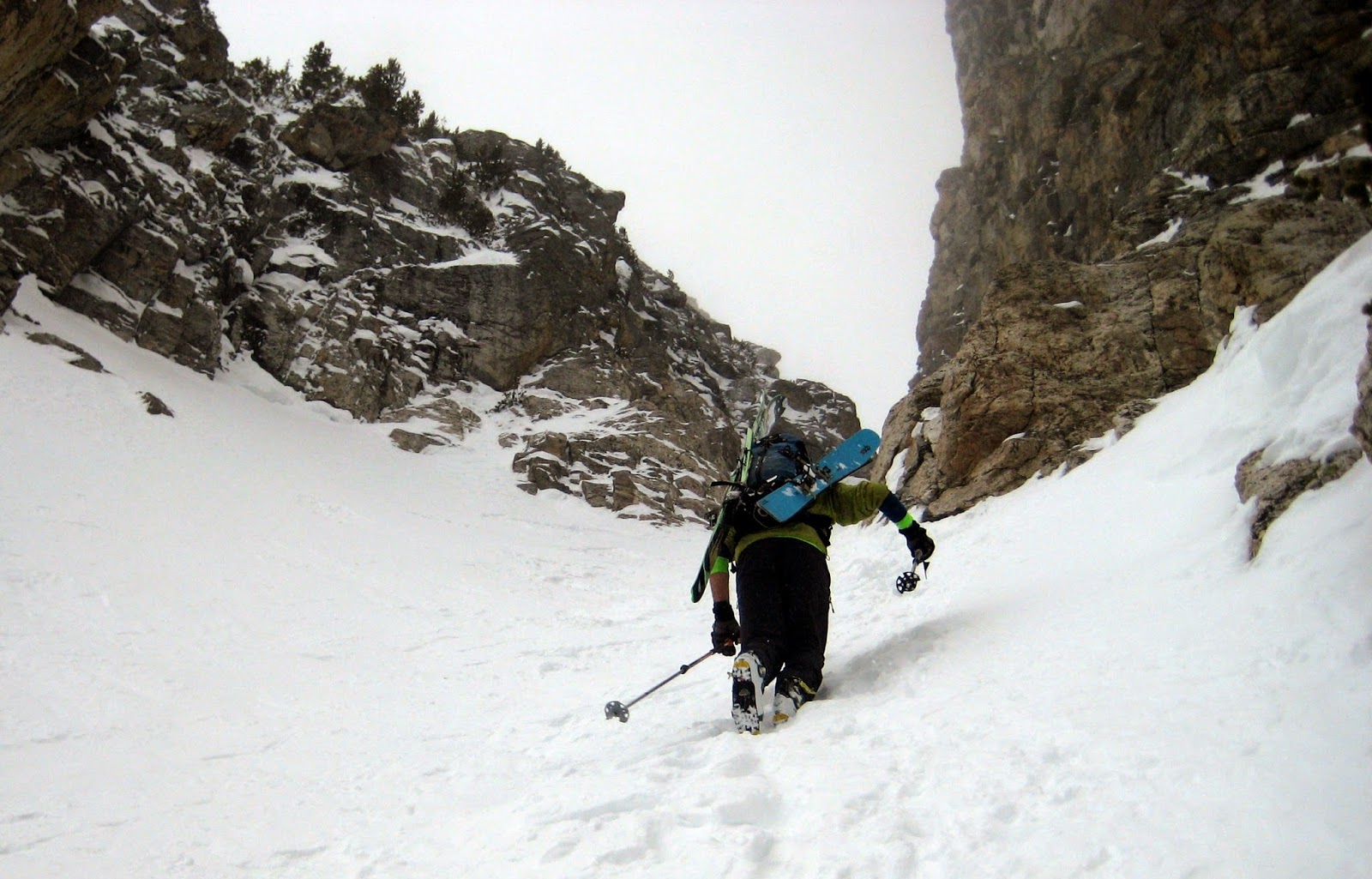
Leah and I have been having an ongoing debate on the relative quality of this ski season. While I still contend this season is on par or better than average, the weather in the past three weeks has not helped my case. Last weekend, the mountains were coated in a dangerous, uniform layer of ice. Despite the stable snow, we bailed on steeper, more interesting objectives and instead headed up Big St. Joseph peak hoping for sun warmed snow on the south face with an acceptable bail option back down the ascent route. The day was gorgeous, and we made good time on the ascent despite surprisingly melted out and challenging climbing in the gully at the base of the peak. Andrew was the only one who had brought ski crampons along, and he put them to good use, skinning everything except the 40+ degree exit from the Southeast Bowl. This was my sixth lifetime summit of Big. St. Joe.
Andrew, getting it done.
Climbing the summit ridge. Photo: Andrew Mayer
It was breezy on the summit, so our stay was abbreviated. We booted west to the highest south gully. Finding sheer glazed ice, we reluctantly booted up and out and back over the summit, expecting to reverse our ascent route. After skiing the summit ridge, we took a gamble and nosed our way down into the eastern most of the three massive south facing avalanche paths on the peak. The snow had softened just enough, so we went for it. The ensuing run was fantastic, with good corn snow and a long, enjoyable fall line with a nice clean rock lined couloir exit. I was elated to ski this big, beautiful run in legitimately good conditions. The exit out Bass Creek has survived the warm wet storm largely intact, and we were out to the car in no time. Good day, and always great to get out with a strong new partners from Missoula. 6,000 vertical feet and done in about 8.5 hours car to car.
Leah and Andrew cruising on the South Face of Big St. Joe
Leah and me coming out of the pinch on the South Face. Photo: Andrew Mayer

Sunday, February 1, 2015

St. Mary to Heavenly Twins and beyond tour

Looking west to Point 8,865 and the Heavenly Twins.
I took advantage of the end of a long high pressure system and the first legitimately low avalanche danger of the year to link St. Mary peak and the Heavenly Twins, skiing as many good lines as possible along the way. Weather the previous week had included record warm temperatures and rain, leaving the snow stable but covered with a veneer of rain ice all the way from the valley to the ridgetops. After a bike shutte the previous night, I left my bivy site at the bottom of the St. Mary road a touch before 5 am. I headed straight up the mountain under the glow of a near full moon, cutting road switchbacks and occasionally checking the map. It was a long dark few hours, and I wandered around a bit at times, but it was all worth it when I hit the St. Mary summit just as the sun crested the horizon, 3 hours and 40 minutes into the day.
I spent several hours doing this before the sun came up.
Sunrise. My shadow. St. Mary Lookout. Ready for a big day.
I descended the rocky South ridge on foot, which was actually quite enjoyable. The Scarpa Alien boots pretty much double as running shoes. I skied a short run in the West Bowl of St. Mary peak before hopping west over the ridge to a long west facing tree lined gully. I took the gully to an unnamed lake tucked away in a high tarn in Kootenail Creek. The line is great, but the snow was very icy, so I took my time, mentally preparing for a day of firm conditions. From the lake, I headed up to point 8,865, armed with ski crampons. The climb went quickly, and I stopped on the shoulder of 8,865 where the slope breaks out to the long summit ridge. I skied the upper Northeast face before taking a hard left down a short gully into another spectacular hanging basin at the base of the Heavenly Twins.
Near the bottom of the snowless south ridge of St. Mary.
The boulder hopping was actally quite enjoyable.
Icy tree lane off the far west shoulder of St, Mary peak. 
Looking down the third run, which dropped to the sun/shade saddle,
then skier's left through a fun gully toward Kootenai Creek.
The climb up out of the basin went quickly with ski crampons, and I was soon poised at the Kootenai/Big creek divide. I took a short, traversing run around the south side of Dissapointment point and paused for a quick lunch break in the sun. Armed with crampons, I booted up to the South shoulder, then around to the Southwest face and up to the fantastically exposed Heavenly Twins summit. I took another short break on the summit, enjoying the wild spectacular perch before downclimbing about 100 feet to skiable snow on the Southwest face. If it were not for the arduous approach and egress, the 3,300 vertical foot Southwest face of the South Heavenly Twin would be one of the classics of the range. The upper face was very icy, but it was just edgeable enough to negotiate the upper 45 degree headwall pitch with a thin but adequate margin of safety. About half way down, the snow softened, and I enjoyed nice corn snow all the way down to Beaver Creek. I slapped skins on one last time and made the big climb up to Point 8,702. The climb was long, but I was feeling good, so I just pushed and pushed and pushed. The extensive upper basin is lined with cliffs and cornices, but I was able to sneak through a small break in the cornice and boot a few hundred feet of terrible frozen facets to the summit.
Climb with a view. At the Kootenai/Big divide, looking north to Big St. Joe.
Scratch marks during the wrap around below Dissapointment point.
About half way down the Heavenly Twins.
I skied the 3,200 vertical foot fall line to Beaver Creek in good corn snow. Once I hit the creek, the tenor of the day changed from a magical dance throught the mountains to a long slog out to civilization. The creek had melted out, and all the rocks were covered in ice, so I just waded the creek with skis on, saturating my boot liners in the process. Ah well. The egress out of Big Creek is just plain long, and after about two miles of steady progress with kicker skins, I put the skis on the pack and walked/jogged/ice skipped the last four miles out to the car. The egress took a mind numbing 3.5 hours, but so it goes sometimes in the Bitterroot. Of note, I parked out at the Glen Lake/Big Creek junction. It adds a mile to the day, but eliminates trechourous icy road driving to a trailhead without a good turnaround. I flicked my headlamp on about 10 minutes before reaching the car, and beer, dry socks, and the contentment of a day well spent skiing dream lines deep in my backyard.
Looking back at the magnificent Southwest face of the Heavenly Twins.
That was fun. 
About half way down the massive south face of Point 8,702.
This is one of the biggest avalanche paths in the Bitterroot mountains.
Ice covered rocks and soggy boots after crossing Big Creek.
Thoughts:
This was a great tour. I got a little greedy and pretty much just skied everything that looked good and logical, but it could be simplified and shortened into a reasonable day. Even though last week's rain and warm temperatures sapped the low elevation snow, the snow seems to be welded together, so it finally feels like go time for bigger, steeper ski runs. Even though the tour was long, I putted along at a moderate, steady pace, returning to the car tired but not wasted.

By the numbers, 13,300 vertical feet and done in 13 hours, 40 minutes. Gear used: Scarpa Aliens, Dynafit Nanga Parbats, ski crampons, ice crampons, one Whippet and one race pole. I brought and consumed about 2,500 calories and by far the most memorable food item was a packet of squeezable MRE peanut butter than kept me kicking along for hours.

Memories to suppress: Fording Big Creek with ski boots, the entire snowless egress, ICE EVERYWHERE.
The route.

Friday, January 23, 2015

Pinball Wizard Gully

Near the top of the Pinball Wizard.

The Pinball Wizard gully is sort of a local classic, dropping cleanly south into Bass Creek from the large saddle between Big and Little St. Joseph peaks. It has a big, committing starting zone, then funnels into a long clean open gully, before pinching down into a fantastic incised halfpipe for the bottom few hundred vertical feet. All in all, it is one of the more accessible and fun 3,000+ vertical foot peak to creek runs in the Bitterroot. Even though the run can be skied with less than welded avalanche conditions, the entire football field sized southeast facing starting zone slides almost every year, and the run demands respect.

I headed out from the normal Bass Creek trailhead in the dark on a random Thursday to try for a fast car to car outing. I was able to follow a skin track for most of the ascent, and the climb went quickly at a bright but sustainable pace. Sunrise was beautiful. The traverse to the top of the gully is scrappy and fairly long, and I added about 5 minutes of ridgeline traversing at the end in order to climb to the safest possible entry point. I have been really leery of the snowpack this year since it just doesn’t seem to be as stable as what I’m accustomed to in the ‘Roots. Nevertheless, I felt confident dropping into the wind loaded but somewhat vegetated headwall. Once I got into the gully itself, the south facing snow had baked down, and the skiing was fun, if not a bit breakable. The schuss out to the car is a little slower than normal, with an open creek crossing and a few down trees. I skied out to the car at 3 hours 31 minutes.
Sunrise on Little St. Joe.
Shadow closing in on the summit of Little St. Joe.
A little crusty, but it was great to ski a clean 3,000+ vertical foot fall line deep in the Wilderness before work.
I had a pretty clean and fast go at this circuit, but it could probably go 15 minutes faster with better conditions and a little more desire to go hard. I bypassed the little rocky summit knob, but the fastest route comes within about 20 vertical feet of the Little St. Joe summit. Even though nothing was slow, none of the conditions were super fast. Avalanche danger was stout moderate, and the terrain requires some attention to detail, so I stopped worrying about time during the traverse and focused on making safe, calculated route decisions. 

Trail report: Bass Creek is in. Continuous ice and snow all the way to the car and plenty of coverage beyond the Pinball Wizard/Lappi Lake junction. Avy danger is a bit funky, but otherwise go get it!

Route: Park at Bass Creek trailhead. Head straight uphill (usually snow free at car) and climb Little St. Joe via southeast ridge. Traverse west toward St. Joseph peak to top of Pinball Wizard gully. Down gully and out on Bass Creek trail. 

Splits were: Summer trailhead: 1 hour 5 minutes; Leave top: 2 hours 25 minutes; Start descent: 2 hours 50 minutes; Upper Bass Creek crossing; 3 hours 5 minutes. Car 3 hours 31 minutes.

Wednesday, January 14, 2015

2015 Randonee Racing post

Whitefish Whiteout, January 17
Ripping skins at the first transition. Photo: Pete Siudara
After a three year hiatus, I returned to race the Whitefish Whiteout. This race seems to serve as an informal Montana match up, since most of the fastest racers from Bozeman, Missoula, and the Kalispell area were present. It was great to see local professional ultra runner Mike Foote toe the line in his first ever randonee race. I actually felt good at the start, and a hard but sustainable effort had me not too far off the lead pack of Philip, Mike Foote, Ben Parsons, and Travis Brown. At the base of the first run, the order was already set for the remainder of the race, with Phillip way ahead, Mike and Ben battling it out, Travis stubbornly ahead, and John Curry and Alan Adams breathing down my neck. 

I had a clean and even remainder of the race, grinding up and down what ended up being primarily easy groomers at a blistering pace. On the last climb, John slowly gained on me, but I was able to hold him off to the top, if only by 6 seconds! I flopped over the finish line totally spent. With the exception of one bad transition and a poor choice of skins, the race couldn’t have gone much more smoothly. My chief complaint with the course was that the last third is not nearly technical enough. The local flavor of this race is that makes it special for me. It is great to see a large turnout of locals with non-racing gear ready to thrown down, and it is fun to have lots of  great local folks cheering everyone on at the transitions. 


Chasing Travis Brown up the NBC bootpack. Photo: Pete Siudara
Results.

Wyo Rando Roundup
This is the fourth consecutive year that I have raced at Jackson, and I always head down for the first race of the year eager and come back beat down. This year was no different.
String of racers on the first climb at Targhee. Photo: USSMA
January 10. Targhee - Slow start, fast finish stage
This course has been slightly modified, and I kind of missed the soul-sucking, straight-up-the-hill first climb. I started slower than normal, and was a little dismayed to top out on the first climb in about 40th place. Over the rest of the race, I was able to advance about 20 positions by skiing aggressively and pushing the second and third climbs as hard as possible.  
Marshall and Lars suffering near the front of the pack. Photo: USSMA.

The skiing was overall fast with some breakable ice at the bottom of the first two runs, which I exploited to pass a few skiers. I started up the last climb right behind Noah Howell and my racing arch-nemesis, John Curry. I couldn’t quite hold their pace, but was able to  pass them both with a fantastic speedy tuck down groomers on the last downhill. I ended up tired but not completely knackered at 1 hour, 52 minutes, in about 23rd place. The rest of the day was spent napping and relaxing in Driggs. On a side note, I don’t think this course is a full 5k of vert, not that it matters.

January 11. Jackson – Redemption stage
The Montana Crew of Ben, Jon, Dave, and me (in the old blue suit) at the start of Jackson.
Photo: GAS Intrinsic Cycling, Bozeman


I did not do the stage 2 sprint, and it was nice to toe the line feeling wonderful. Last year I got dangerously cold and had to stop in Corbett’s Cabin, so I was eager for another go at this beast of a course. I started slow again, pegging the heart rate just above 160 as the fast guys sprinted away. Unlike yesterday, I was able to slowly pass about six racers on the first climb. The first descent was fast and easy. I stopped to suck down a GU packet at the start of the second climb and lost a few places, but was soon back on track, working up the slippery skin track. I maintained position on this climb. I was hoping to pass Jessie Young on the Tower 3 chute downhill, but she simply out-skied me. After a good transition, I held back a bit on the third climb due to mounting fatigue and worries about cramping. Both Lindsay and Alan Adams came by on the cat track, but I was able to pass them again on the next mini-downhill. I have traditionally been totally spent on the fourth climb, and this time around it was nice to have enough energy reserve to move well and advance one position at a moderately hard effort. The modified booter did not go up Corbett’s, but it was still fun and engaging. I always thrive on the big 4,000 foot top-to bottom downhill and let ‘er rip all the way down, passing about five people in the process. As fate would have it, I transitioned with John Curry and Noah Howell again, and blazed out in pursuit. It was clear that I was going to be able to get through this race cramp free, so I pushed hard on the last climb. We all pulled away from a little chase group of Jessie and Michael Hagan, but I was not able to catch Noah, and John opened a hopelessly large gap. I skied the last run in no-man’s land, crossing the finish line in good spirits at 3 hours, 1 minute, in 23rd place. 

Racers cruising down Tower 3 Chute. Photo: MarkGocke 
In retrospect, I think I could have dug a little deeper and found as much as 5 minutes on the climbs on this course, however such an effort would have taken a lot of mental fortitude, and could have very easily backfired. In the end, I was satisfied to finish both races in solid (for me) times without ever blowing up.
Jackson Men's results

Thoughts
This is the first big ski race of the year, and serves as an informal annual gauge on my high-end fitness. It seems like I have become smarter and slower in equal proportions, yielding no measurable change in overall race times. However, with a more calculated, balanced approach to training, my body is much happier than it was a year ago, and it was nice to feel a little more within my capabilities during the races. So I am happy over all.

Two days after the race, I am largely recovered. What a pleasant change from long running races, which seem to require about a week of recovery before the old pins come around. I really enjoy the endurance component of these two-day stage events.  

It is always good to see the familiar faces at these events – what a great group of people. It was also exciting to see my Montana friends stepping up their game. Go Montana! Also, I had a great time battling the second and third place women at both races, and it was encouraging to see a strong and deep women’s field.

These races are big efforts for the organizers and volunteers, and I can’t thank everyone enough for all the work and encouragement along the course. Of Note, Nate Brown spent a lot of time constructing the last skin track, and it was a pleasant surprise to find it in an easy condition after years of fighting tooth and nail to finish the course. Buy him a beer next time you see him.

Tuesday, January 6, 2015

Tetons, Sliver Couloir

The Tetons welcomed in 2015 by dropping a massive slab avalanche off the East face of the Grand.
Can you spot the crown? Photo: Leah Samberg Story
I was able to sneak away to Jackson for a few days with Leah to ring in the New Year and play in the Tetons. While Leah was able to take advantage of a full week of bitter cold blue skies and stable powder, I was only able to ski for three short days. By showing restraint on New Year’s eve, we were able to put in a solid tour on Shadow Peak on New Year’s day, with a tracked out but enjoyable descent of the Four Hour couloir into Avalanche Canyon. The highlight of the trip was a descent of Nez Perce’s Sliver couloir with Leah. We were thrilled to find stable neve, and I was glad to check this little gem off the list. We did not ski the upper 50 feet, however, and I am of course excited to go back and link the complete Sliver with the East and West Hourglass couloirs. Before driving back to Missoula, I was also able to squeeze out a nice quick run in Jenson Canyon, taking advantage of Low/Moderate avalanche danger to gut punch one of the big avalanche paths in stable powder, solo. 


Natalie saluting in front of Teewinot. 
Natalie skiing into Four Hour.
Skiing out is serious business. Photo: Natalie Dawson
Grinding up the Sliver. Photo: Leah Samberg Story
Starting down the Sliver. Photo: Leah Samberg Story
Lower in the Sliver. Photo: Leah Samberg Story
First few powder turns in Jensen Canyon.
I had a full Dynafit binding failure on the first day when the newly repaired toe units on my Speed Superlight bindings would not come unlocked. It turned into a minor epic, but nothing too terrible. This is the fourth malfunction of Dynafit bindings I have had in well over 1,000 days of use, so I can’t complain, but the failure put the durability of the Speed Superlight toe unit into question, which is somewhat unfortunate since the toe units are otherwise a good compromise between the normal Dynafit speed toes (a little too heavy), and the auto locking Dynafit race toes (awesome but do not release).